The Prophet’s Fingers: a roadmap towards the reinstatement of common spaces stewarded by self-governing communities


3. . . the dichotomy of the institutional world into private property exchanges in a market setting and government-owned property organized by a public hierarchy. The people of the world were viewed primarily as consumers or voters.
. . . farmer-managed systems are likely to grow more rice, distribute water more equitably, and keep their systems in better repair than government systems. While farmer systems do vary in performance, few perform as poorly as government systems.
. . . Chhatre and Agrawal (2009) focus on factors that affect tradeoffs and synergies between the level of carbon storage in forests and their contributions to livelihoods. They find that larger forests are more effective in enhancing both carbon and livelihoods outcomes, particularly when local communities also have high levels of rule-making autonomy.
Life in the city (and suburb) is made possible by the resources harvested from non-(sub)urban spaces. As sprawl increases the distance between consumers and the resources they depend on, there is a corresponding decrease in the opportunity for consumers to have a hands-on relationship with the sources of the material they depend on.
A world furnishing little opportunity for a symbiotic relationship with a particular place alienates its inhabitants, thus producing behavior which tends towards the extractive rather than the symbiotic.
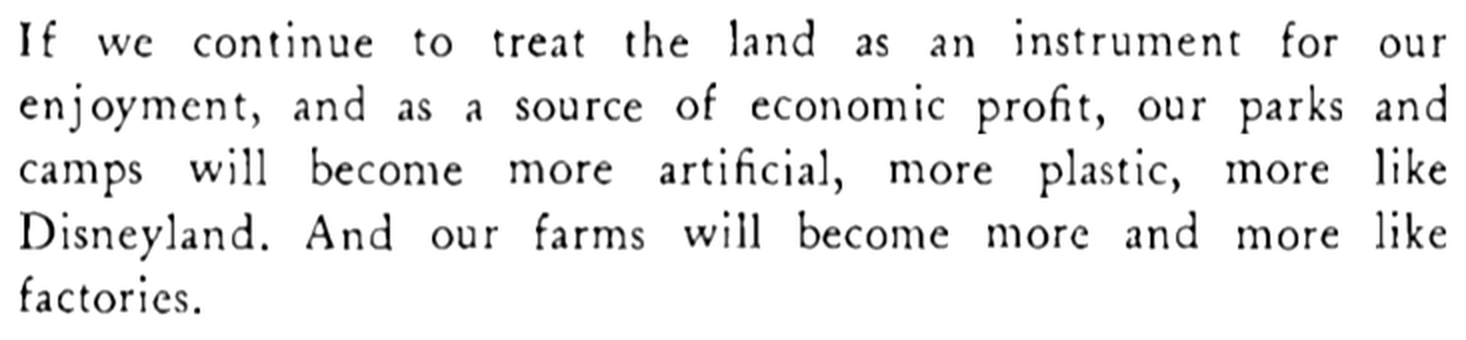
Symbiotic relationships imply the opportunity to both give and take. The tourist and miner only take, while the conservationist fights to preserve what is. The steward, however, takes to give and gives to take, collapsing the very distinction between selfishness and selflessness.
A parallel problem is the decline of common spaces, held and stewarded by the group it is common to. Instead, nearly all land is either fully private or managed by governmental bodies.
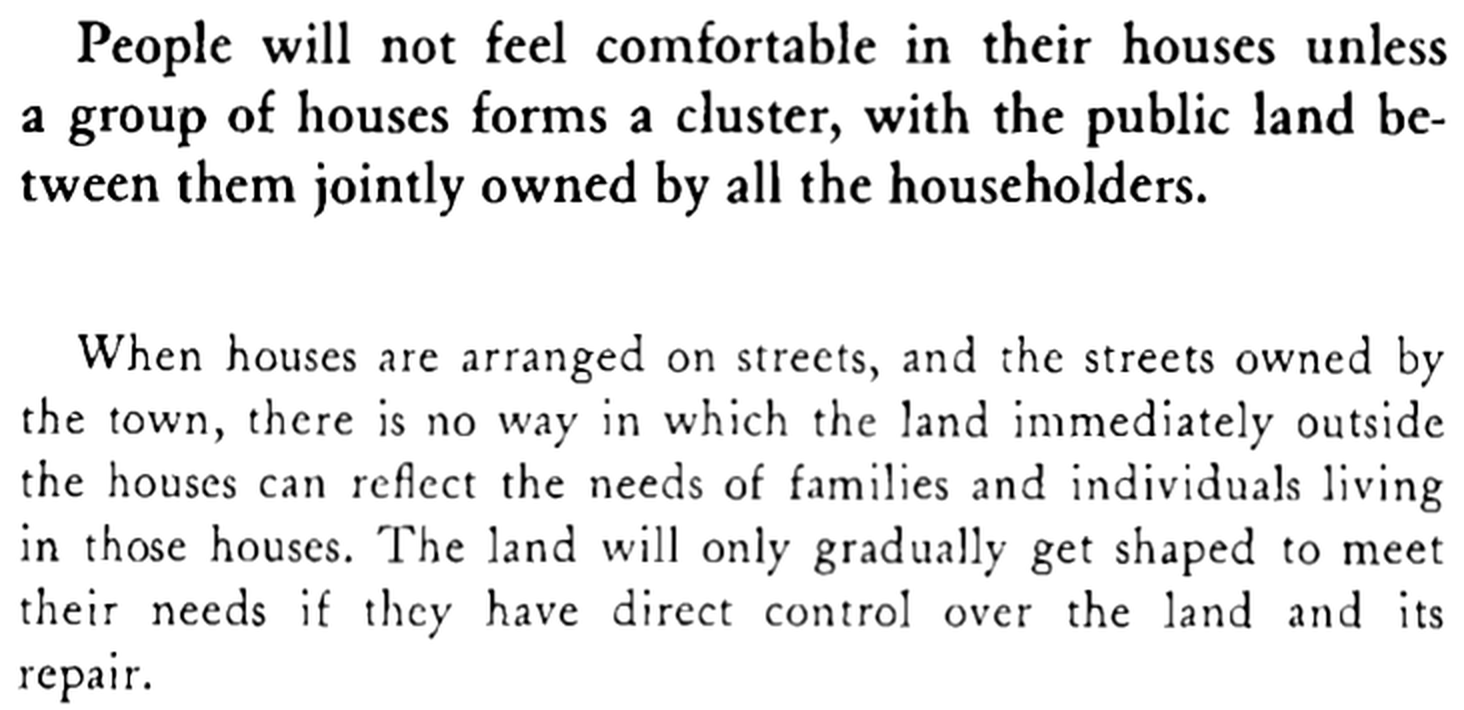
The social fabric of our communities is greatly enriched when we come together, in reasonably sized groups, to give and take from land that we need and that needs us.
Common spaces which are neither private nor managed by a centralized governmental body have the power to bring us together in ways which have been largely forgotten in our times.
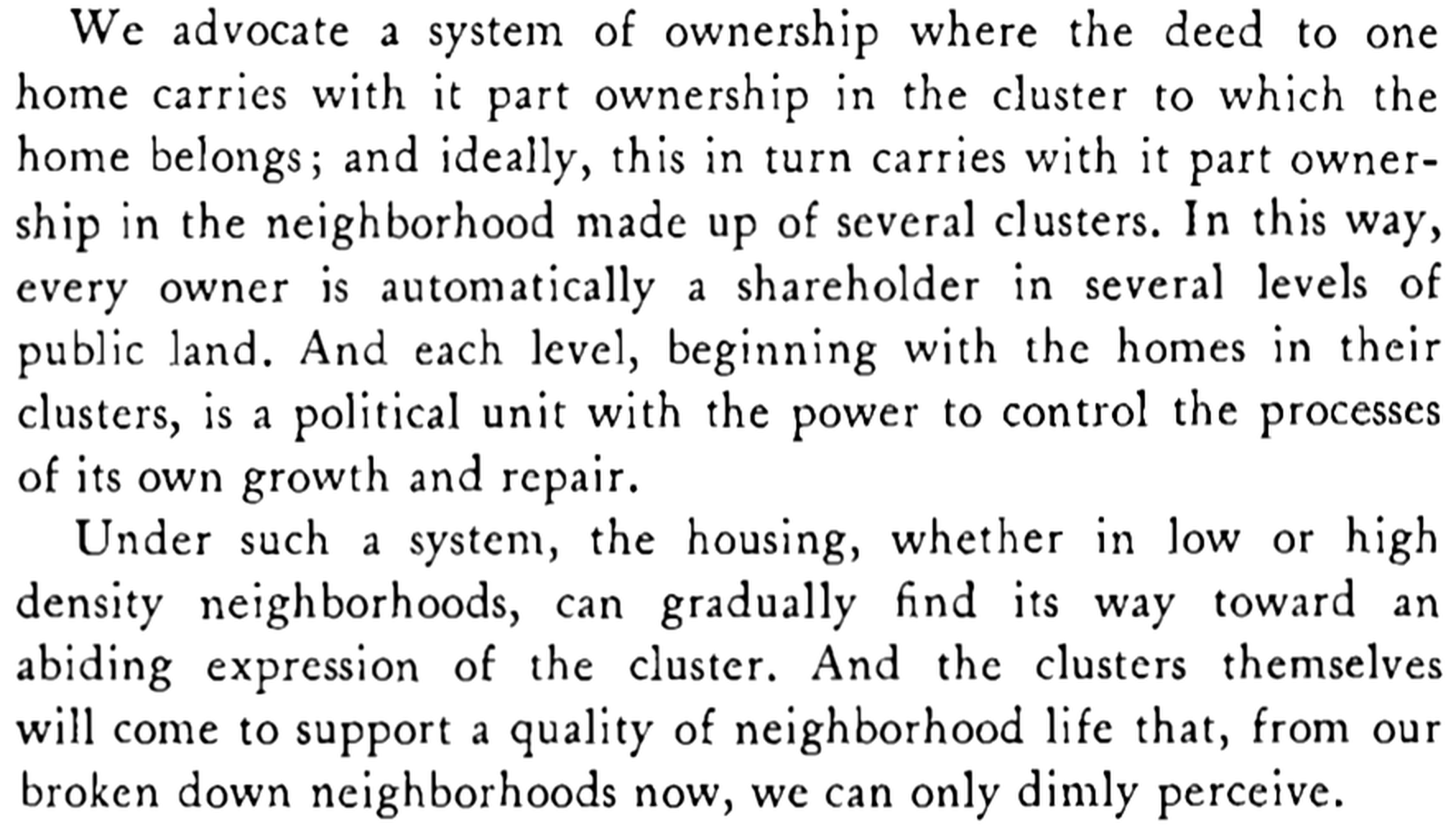
The solution to the pervasive (sub)urban alienation from community rooted in a shared relationship with Land is the radical rezoning project identified in pattern 3 of A Pattern Language.
But radical rezoning won’t happen overnight.
The goal of The Prophet’s Fingers (TPF) is to pave the way for widespread adoption of pattern 3 by establishing small-scale precedents for reshaping the surface of planet Earth so as to maximize opportunities to engage in collective land stewardship within the constraints of the dominant paradigms shaping our environments.
We are impatiently awaiting radical rezoning projects which will reshape the surface of planet Earth so that human communities have physical access to land and the opportunity to steward it, replacing the current system, wherein we pay taxes so that bureaucrats can manage, without our direct input, the public land we do have access to.
Top-down governmental policy, however well intended, cannot by itself keep our ecosystems healthy. For people to care about the environment, they must have opportunities to care for an environment in a hands-on way.

- Identify spaces, however small, which are good candidates for communally managed plots stewarded by self-governing communities.
- Recruit locals and provide educational and material resources relevant to the projects they commit to.
The following three projects lay the groundwork for broader implementation of the City Country Fingers pattern by establishing small working examples embodying its underlying principle.
Pilot project 1POWER LINE GARDENS
Coordinating between power companies and the neighbors whose residences abut or are near power lines to manage the growth of the area under the lines through community gardens. Shares of plant stock, produce and, where applicable, animal products are divided among the members of the collective, who together establish protocols for managing those spaces.
Pilot project 2RECLAIMING ASPHALT
Neighborhoods securing code variances to reclaim space from cars for pedestrians, using the process Christopher Alexander lays out in The Nature of Order, Book 3, A Vision of a Living World.
The neighborhood is mapped in four colors: red for cars, yellow for people on foot, green for gardens and gray for buildings. Variances are then sought step by step to shrink the red and break up its continuity, so that the yellow can grow and the green can take on a coherent shape.




Christopher Alexander, The Nature of Order, Book 3: A Vision of a Living World
Pilot project 3MICRO COURTYARDS
Micro courtyards established where four residential house plots meet, eventually opening into green corridors that serve as rights of way connecting one multi-home micro courtyard to another. Each courtyard is governed by its own members. Where courtyards connect, they form a second level of self-governance for the shared corridor.